The Train

For my 60th Birthday Weekend I took the train on Wednesday to NYC. It was a beautiful ride following The Mad River, to the White River to the Connecticut River to the sea and then the coast to the city.


I spent Wednesday and Thursday nights on the Upper West Side with Dianna and Balty, their two kids and the cat on the 6th floor overlooking the city. They were very gracious hosts who let me sleep on their fold out sofa in the living room of their apartment which iswhere Balty grew up and still lives!

The Frick

On Thursday I walked through a drizzly cool Central Park to 5th Avenue where I waited outside the Frick for my 12:00pm entrance slot.


Henry Clay Frick was a steel tycoon during the Gilded Age. He was responsible for the union busting that led to the violent Homestead Strike. He was also mostly responsible for the Johnstown Flood that killed over 2,200 people when he altered the dam to accommodate a private luxury resort on the reservoir behind it built for himself and fellow tycoons.
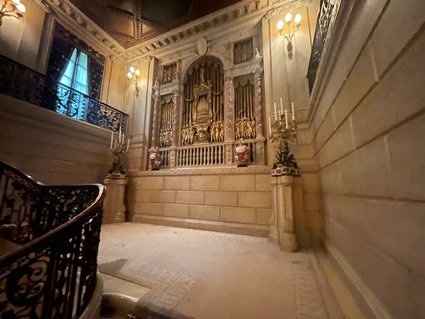
His palatial house is now a museum housing his collection of art acquired from the toil and blood of the working class which he and his like exploited.

The following are some of the art that drew my eye!

Agnolo Bronzino (Agnolo di Cosimo di Mariano)
Florence 1503–1572 Florence
Lodovico Capponi, 1550–55
Thought the cod piece was funny 🙂

Giovanni Bellini (ca. 1424/35–1516)
St. Francis in the Desert, ca. 1475–80
The painting was commissioned by the Venetian nobleman Giovanni Michiel, probably as a devotional piece for his collection. By 1525, it had entered the collection of the prominent aristocrat Taddeo Contarini. The panel most likely depicts one of the key scenes from the iconography of St. Francis of Assisi (ca. 1181–1226), the moment when he received the wounds of the Crucifixion (stigmata) inflicted on Christ during the Passion. This is said to have occurred in the summer of 1224, while the saint was at La Verna, a site in the Apennine Mountains of Italy. Bellini shows St. Francis in contemplation, standing in a large and beautiful landscape. The palms of his hands display the wounds, while the landscape and animals around him highlight his close relationship with the natural world

Elizabeth, Lady Taylor
Joshua Reynolds (British, 1723–1792)

François Boucher’s “Spring” from his “Four Seasons”

“Wisdom and Strength” painted in the 1500’s by Paolo Veronese. It depicts the human condition and has a lesson for us 500 years later. No matter how unique an individual may be they do not exist alone. Humans are not solitary beings we exist in community and only in communities do we thrive. The two figures in the painting reflect that as well as the dysfunction that has made such a mess of our social history. Wisdom, the capacity to do what is best is looking up and away seeking a answer that is not of this world. Strength is looking down at the earth firm in his power and control. These two should be looking at each other for Strength is only justified when enacted with Wisdom. When opposed as in the current global situation going back thousands of years we only get devastation and ruin. Art has the power to heal. This pictures and other works should be free to all as museums and galleries are in most other countries.

Constant Troyon, “A Pasture in Normandy”

Claude Monet’s “Vetheuil in Winter”
Central Park
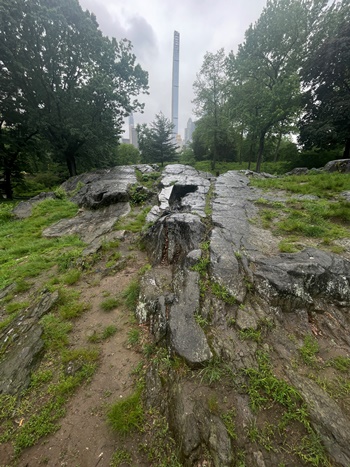
After spending 4 hours at the Frick I walked south through the park and got some dinner at a deli on 58th and 7th.


“Dead Outlaw”

I am seeing 4 musicals while in the city and this was the first.


It was okay, no memorable songs, at times I wasn’t sure whether I was watching a musical or a bar band performing skits.
The Cloisters

On Thursday I took the subway North to the Bronx and the Met Cloisters.


The Met Cloisters is a collection of French Monasteries brought stone by stone from France and reassembled into a series of interconnected galleries and gardens housing a collection of Medieval relics, tapestries and objects. The collection and site were donated and funded by the tycoon J.D.Rockefeller. The buildings and grounds are beautiful. The Cloisters is built up high on a remarkable outcropping of sedementary schist made up of silt layers from a 500 million year old seafloor.


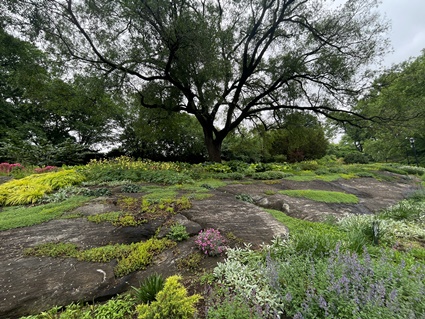
The view over the Hudson as been admired by the Lenappee as well as the Dutch and English settlers who forced them out. Inside I got tired of all the Christian iconography. While beautiful, it felt like the tomb of a religion that is 1000 years out of date. The real spiritual feeling was outside and I spent more time among the rocks and the trees and the views in Fort Taylor Park.


Fort Taylor Park


The Morgan Library
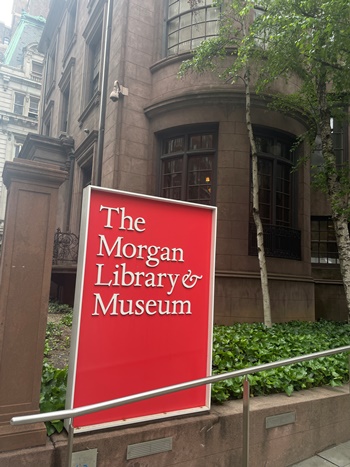
Continuing my tour of New York City tycoons homes turned museums with the Morgan Library & Museum on Madison Avenue in the shadow of the Empire State Building. One really needs to look up at that building. It is so massive. The Morgan Library is the least favorite among the tycoon homes turned museums, I have visited because it mostly contains books; lots and lots of old books. Also access to his home is limited as Morgan’s original brownstone had been turned into a gift shop and offices for the museum staff, not at all as sumptuous as the private home that contains Frick collection uptown.

That said I was impressed with the antiquity of some of the items contained in the old librarian’s office especially the carved cylinder seals dating from around 1800 BCE. I’ve seen cylinders like these before, but the Morgan Library actually rolled them out fairly recently into clay so you can see what the impressions look like that were used to emboss the cuinform tablets. The detail and imagery is quite impressive for such a small carved cylinder. You can get in free if you show them a SNAP/EBT card so that is a plus, access for all. Really not worth the entrance fee. Opt for the Frick instead.
The NY Pubic Library

The New York public library was a treat after the Morgan Library; not only was it free. It had exhibits that contained items comparative to what was found in both the Frick and the Morgan Museum. The building’s architecture and interior are sublime and really what better place is there that is better than a public library.


There was an exhibit commemorating the 100th year of the New Yorker on the third floor and I found a New Yorker cover from my birthday in 1941!

On an interesting note outside the museum, flanking the entrance was a variation on the wisdom and strength painting I saw the Frick. Here named Beauty and Truth these two archetypes are everywhere that I look now. In plain sight are clues to the healing of the social dilemma we have been suffering for thousands of years.


The same theme is also in the façade of the Rockefeller Building in Rockefeller Center.

NYC Skyscape


“Floyd Collins”

Friday night my musical was Floyd Collins. I was drawn to it because I came across the story when Colleen and I visited Mammoth cave 20 years ago and I bought and read the book about it. It’s a true story of a man trapped in a cave in the 1920’s that because of newspaper reports and radio broadcast became a national story that riveted the nation. Colleen’s Maternal Grandpa Jack remembers it from when he was a boy.
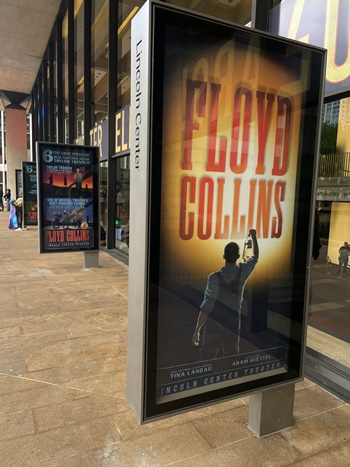

It was at Lincoln Center!


It was good, no dancing or memorable songs and the staging was innovative but probably not the best subject for a musical with the lead trapped and unmoving on stage.

Jeremy Jordan was the lead, I’d never heard of him but the girls next to me were here because of him as he is a well known Broadway actor. He made his Broadway debut in 2009 as part of Rock of Ages. Subsequently, he went to star in the original Broadway musicals Bonnie & Clyde (2011) as Clyde Barrow and Newsies (2012) as Jack Kelly, for which he was nominated for a Tony Award and a Grammy Award. He has also appeared in a Broadway revival of the musical West Side Story as Tony, the musical adaptation of Waitress on Broadway as Dr. Jim Pomatter, and the play American Son on Broadway. In 2021 and 2023, he starred as Seymour Krelborn in the Off-Broadway revival of Little Shop of Horrors. He made his return to Broadway in the title role of the original cast of The Great Gatsby in 2024 and is playing the titular character in the Broadway premiere of Floyd Collins in 2025, which earned him his second Tony Award nomination.
On screen, he starred opposite Anna Kendrick in the 2014 musical film The Last Five Years and as Jimmy Collins in the NBC series Smash (2013). From 2015 to 2021, he played Winslow “Winn” Schott Jr. on the CBS/CW DC Comics-based superhero drama series Supergirl. From 2017 to 2020, he voiced Varian in the Disney Channel animated series Rapunzel’s Tangled Adventure. Since 2024, he has voiced Lucifer Morningstar in the adult animated musical series Hazbin Hotel, for which he received an Annie Award nomination for Best Voice Acting
Colleen and Jakobi Arrive!

After the show I took the 1 train to the Bronx where Colleen and Jakobi were awaiting me at Donna’s. The next day was my birthday and we celebrated it at breakfast at a diner in Yonkers before heading Downtown to the first of our tow musicals!
“Maybe Happy Ending”
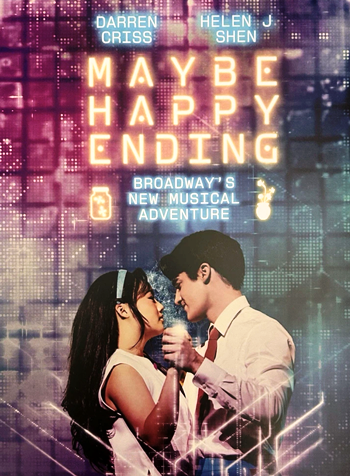


“Maybe Happy Ending” starred Darren Criss of “Glee” as a robot looking unbeknownst to him for love. It was beautifully staged and acted with good songs and excellent visuals and projections. 5 STARS!!!


Afterwards Jakobi waited by the stage door and got all of the cast but Darren, who didn’t come out, to sign her playbill!
The Greek Kitchen

We then walked uptown to the Greek Kitchen for dinner. It’s Jakobi’s favorite restaurant and we visit it every time we come to New York!

Then it was back downtown for the 4th and final musical of my birthday weekend!
“Sunset Boulevard”


Even though Nicole Scherzinger was not playing Norma Desmond this musical was still a force of nature. Great songs, staging and dancing. Lots of video projection including the opening song of the second act which wanders backstage and out on the street. Definitely spectacular!
The Met

On Sunday we wrapped up the trip with a visit to the MET where I ate my breakfast by a 3500 year old Egyptian obelisk known as Cleopatra’s Needle gifted to US in 1879. It was found buried in the desert sands of Alexandria on its side. Its companion is on the banks of the Thames in London. The hieroglyphics on its Western side are considerably eroded do to the prevailing winds and acidic rain. Beautiful piece of ancient stonework.


Inside I wandered around with Jakobi taking an interest in what she took an interest in.

Colleen only wanted to see “WILLIAM” the HIPPO familiar to her from a book she used to read Ambiana and Jakobi when they were little. We have all met WILLIAM before but this was her first time!
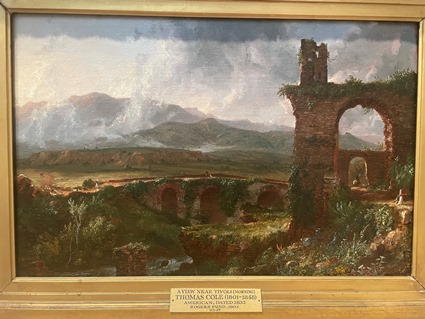
We headed then to the 2nd floor of the American Wing to look at the landscape paintings of the Hudson River School which include my favorite of them all Thomas Cole. Cole was born in England and made two later extended visits to Europe, where he painted views of the scenery to vie with his American vistas. The landscape of Italy particularly interested him, and he drew on the artistic conventions of European masters such as Claude Lorrain to portray it. In the spring of 1832, he made sketches in the Roman Campagna, but he did not paint this canvas until after he returned to Florence in June. Later, in 1834, he described the work in a letter: “A view near Tivoli, representing a bridge, and a part of an ancient aqueduct, called ‘Il Arco di Nerone’: a road passes under the remaining arch; it is a morning scene, with the mists rising from the mountains.”

Thomas Cole (1801–1848) enjoyed the patronage of influential New Yorkers, including the merchant Jonathan Sturges, who owned this bust by 1850. After the landscape painter’s untimely death, the city’s cultural elite moved quickly to eulogize him, and this portrait was probably modeled as part of that effort—not during Cole’s lifetime. The work partakes of Brown’s customary blending of a highly realistic likeness with a conventional classicizing drape. The striking resemblance to a daguerreotype of Cole by Mathew B. Brady, then on view at the photographer’s Broadway gallery, may be more than a coincidence, for Brown would have looked to lifetime likenesses of Cole as an aid in modeling his own.

I love the ambient light in this picture by Sanford Robinson Gifford (1823-1880) – A Gorge in the Mountains (Kauterskill Clove) 1862. This the first major work in a series of vertical compositions of Kauterskill Clove, in the eastern Catskill Mountains, that Gifford executed up until his death in 188o. Before him, Thomas Cole and other artists had emphasized the sublime, or fearsome, aspect of the storied locale. In Gifford’s painting, a hunter and a dog climb the rocks at left, overlooking a ravine dominated by gauzy atmosphere and dazzling light an effect reminiscent of the work of the influential English artist.
Gifford was the only major Hudson River School painter to have actually grown up in the Catskills region of New York made famous by Thomas Cole, the school’s founding figure. Rather than focusing on a central mountain or waterfall, as had most artists in earlier depictions of the landscape, Gifford chose to feature light and atmosphere as viewed from Kauterskill (Kaaterskill) Clove in the eastern Catskill Mountains. The result is a shift from the sublime to the meditative. A hunter and his dog climb the rocks at the left, merging with the terrain as they make their way to the platform overlooking the ravine, which is burnished by an Indian summer haze. From 1845 until his death in 1880, Gifford chose Kauterskill Clove in the Catskill Mountains as one of his favorite subjects. This painting, dated 1862, was called “Kauterskill Falls” in the catalogue of the 1876 New York Centennial Loan Exhibition of Paintings, as well as in the 1881 official catalogue of Gifford’s work. The title has since been changed to “Kauterskill Clove,” for the view is from the east, looking west to Haine’s Falls at the head of the clove.

John Brown caught my eye not only because he looks like the kind of person we need around today but also because the image is also on the band KANSAS first self-titled album from 1974
John Stuart Curry (1897-1946) John Brown 1939. In the mid-twentieth century, Kansas native Curry reprised the subject of his John Brown mural in the rotunda of the Kansas State Capitol. Before the radical abolitionist’s 1859 raid, trial, and execution in Harpers Ferry, Virginia. Brown was known for his violent response to the extension of slavery into the Kansas Territory. Curry depicted the freedom fighter in a dramatic landscape besieged by a tornado -symbolic of the Bleeding Kansas crisis- with a Black American figure at his side. Brown’s crazed expression suggests the messianic fervor and wrath that fueled his armed rebellion.

The album cover depicts abolitionist John Brown in a scene from Tragic Prelude, a mural by Kansas native John Stuart Curry.[ The original mural is painted on a wall at the Kansas State Capitol in Topeka. The album cover image is severely discolored and cropped to show only a small part of the original painting.

Tragic Prelude is a mural painted by the American artist John Stuart Curry for the Kansas State Capitol building in Topeka, Kansas. It is located on the east side of the second floor rotunda. On the north wall it depicts the abolitionist John Brown with a Bible in one hand, on which the Greek letters alpha and omega of Revelation 1:8 can be seen. In his other hand he holds a rifle, referred to as the “Beecher’s Bibles”. He is in front of Union and Confederate soldiers, living and dead, with a tornado and a prairie fire approaching. Emigrants with covered wagons travel from east to west.

Mt Mansfield is the highest peak in Vermont, I’ve climbed it once. Ambiana climbed it the first week in May this year. Love seeing it without all the antennae and towers that are now upon it.
Jerome B. Thompson (1814-1886) The Belated Party on Mansfield Mountain – 1858 Thompson, who traveled widely in New England during the 1850s, earned a reputation for paintings that combine panoramic landscapes with narrative detail. This work is one of several in which he used Mount Mansfield, Vermont’s highest peak, as a setting for a social gathering. Half the day-trippers admire the summit and the vista toward Lake Champlain, while a seated young man holds his watch aloft, warning of the lateness of the hour and the need to descend. The three figures watching the sunset pointedly ignore him, enraptured by the beauty of nature.

I love reading about Arctic Expeditions in the 1800’s so it is a treat to see a painting depicting the Arctic painted during that period.
William Bradford (1823-1892) An Incident of Whaling – 1880’s. Oil on canvas. Bradford began his career painting marine vessels in the whaling port of New Bedford, Massachusetts. He made seven expeditions to the Arctic regions during the 186os, one of the first American artists to do so. Based on sketches and photographs made on site, his detailed seascapes record ships and their rigging as well as the light, color, and atmosphere of the dramatic, desolate environs. This view of a whaler trapped in ice floes was completed in Bradford’s New York studio, likely in the 188os, when the American commercial whaling industry had long been in decline.

I really like the mood of this painting; sunset with a crescent moon. Very peaceful.
Jules Breton – 1827-1906 The Weeders, 1868. This is a smaller variant of a composition Breton painted in 1860 (Joslyn Art Museum, Omaha) and exhibited to wide acclaim at the Salon of 1861 and the World’s Fair of 1867 in Paris. In his autobiography, Breton described this twilight scene of peasants pulling up thistles and weeds-“their faces haloed by the pink transparency of their violet hoods, as if to venerate a fecundating star” -noting that he had discovered the subject as a «finished picture” near his native village, Courrières, in northern France.

We finished our visit at my favorite painting “The Storm: by Pierre-Auguste Cot
Jakobi

Jakobi had a track meet on Tuesday!

Meanwhile in Germany…